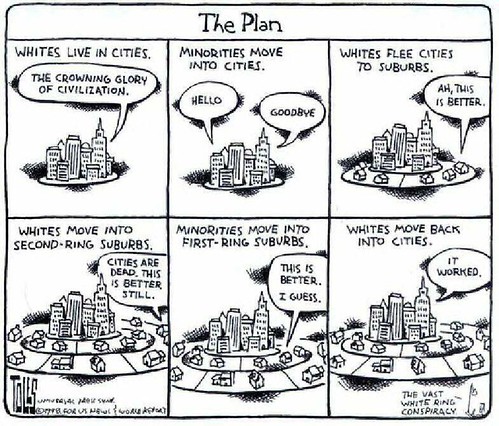
gentrification
My dad, in his spare time, loves sending me editorial cartoons that he thinks I'll find either funny or accurate. He sent me this cartoon a while back and I thought it has some significance to the ideas brought up in the reading we did this past weekend. The controversies that lie behind gentrification projects bring up the idea of racial re-segregation and socioeconomic exclusion. This cartoon, while obviously oversimplified, does a good job of both making light of a very disturbing trend as well as point out some serious flaws within the logic of urban housing.
Reality vs. Hollywood: Slumdog Millionare
http://articles.latimes.com/2009/jan/24/world/fg-india-slumdog24
While doing the reading for Monday, I kept finding myself picturing scenes from Slumdog Millionare. This article was featured in the LA times in 2009 shortly after the film was released in Mumbai. While it may have won best picture in America, it was not at all well received in India. The majority of the criticism of the film was due to it's romanticizing of the poverty in Mumbai we read about in "Spectral Housing." At first, I agreed with the critics in that Slumdog glamorized some of the most awful realities faced by the millions of homeless, impoverished individuals in Mubai. However, after reading the piece on Mumbai, I find myself thinking that this highly controversial film has an additional effect. While it certainly does glamorize the slums in India, it also calls to attention the vast inequality in both India and in many other major cities. After finishing this reading, I was able to re-examine my initial feelings about Slumdog. Instead of seeing it as perpetuating negative stereotypes about India and glamorizing the slums, I now see the film as a sort of wake up call. We are uncomfortable with the portrayal of the slums not because they are glamorized but because they are too close to reality. Being made so blatantly aware of the totally disproportionate distribution of wealth would make anyone squirm in their seats. The reading not only helped Slumdog regain some credibility in my eyes, it served as yet another reminder that beneath all the glamour of the cities, entire populations of people exist that are striving to gain some sort of social and economic visibility.
Street Art Assignment
The view from the top of the garage is remarkably scenic. When you're on the roof of any building in Boston (or any city for that matter), there is this sensation of omnipotence. It's as though because you can see the whole city, the whole city can somehow see you. The sticker and lamp post seems so large up against the city backdrop, which visually replicates that invigorating sensation from looking out at the city from the rooftop of a building.
I now see why many street artists choose to write on high up places (like in Exit Through the Gift Shop when Shepard Fairey is shown placing numerous prints on roofs of buildings and on highway overpasses). Not only does this accomplish the task of giving a voice to the voiceless, it places the message literally above where the craziness of everyday urban life occurs. It's as though the message will somehow trickle down to the streets, which to me is a very cool concept.
So my placement of the sticker on this lamp post accomplishes my attempt to give meaning to an otherwise meaningless lamppost on a parking garage. It now invites whoever sees it to think about how they see themselves compares to the city, and it tempts them to think bigger and not be overwhelmed by the size of the city. It allows for me to feel important as the writer for getting attention, and it also allows people to indulge in that momentary rush of looking down at a city and feeling as though you are floating above it. It's also just a nice view.
Will the Decentralized Dance Party come to Boston?
I recently got invited to one of these decentralized dance parties (DDP) that is supposed to take place in Boston on Facebook. I clicked on the event, and after reading the description I found many similarities between these DDPs and the Reclaim the Streets movement Naomi Klein discusses in her essay. I also thought it added interesting insight with regards to our discussion on youth culture and the emergence of the hipster as someone who feels the need to go against what everyone else considers the norm.
The DDP is meant to challenge and reevaluate the idea of public space in that it essentially turns a large, urban location into a giant nightclub. The party is given a theme, and people are supposed to dress up accordingly. They are encouraged to bring large props as well a portable stereo system through which the party music is played. All of the radios are tuned to one broadcast station that the DJ plays his music through. People are encouraged to dance and have a good time, but the creators of this movement strictly say in their "party manifesto" that alcohol consumption and overly rowdy behavior will not be tolerated, and that police are usually supervising the parties to ensure everyone's safety.
To me, these parties are a variation on the RTS movement's idea of ridding cities of privatized space. THe only difference here is an absence of a political message. The DDP isn't a protest or a demonstration, but I definitely think that the creators are trying to convey something more meaningful than just a party. With social networking technologies providing widespread accessibility to these events, these movements are able to garner a large turnout. There have been several successful DDPs already, and I am very curious to see how this proposed Boston one will turn out.