
My roommate's mother is as poignant as she is beautiful. When asked about navigating Boston, she shrugs lightly and says, "All roads lead to Chinatown." A month later her words are still floating around in my head.
Food is a tragically overlooked indicator of a global city. In fact, the integration of new styles of cooking and food is, in my mind, a necessary element of any city that claims global status. Perhaps, the most important necessary facet, far above development and wealth which only effect a limited number of individuals and as we've read cannot be considered the only attributes of global city status.
In particular, the presence of Asian inspired alterations to menus inside and out of restaurants all over a city, say Boston, radiate from the establishment of Chinatown, whichever city you may be in. (Or for that matter, any ____town or Little____ which may vary from city to city.) People move in, new foods become available, new restaurants open, things are shared and adopted.
In my mind mixing and blending of taste and style is always a good thing. Anthony Bourdain, (one of the main players in the food-anthropology trend which has been made increasingly accessible by the Travel Channel) shares my sentiment that in terms of local food, global influence can only make things better. The clip shows the range of influence which can be seen through food in cities from Lebanese to Szechuan in this specific example. Yet most importantly for this discussion, towards the end of the clip featured, about 13:00, there's a conversation about how the surge of immigration after strict limits where lifted in Melbourne and the effects of a developing Chinatown on the local preference for food. Within the episode, No Reservations: Australia, which if you have Netflix you can watch, you can see how more and more restaurants (and thus people) are adapting Asian inspired dishes from cooking style to ingredient choice. Is this an occurrence symptomatic of a global city? Have all food trends (the growing popularity of sushi is another different but intriguing example of global food influence) originated from global cities in some way?
Perhaps in the debate between global or not we should look at food as primary source of information since it is the ultimate reflection of the people who inhabit the city and the global connections and networks within.
- Alexis Brinkman
Food & the City


The Suburbanites
One of the most intriguing items we looked at in this class was the film "In the Suburbs." From the photos hanging on the walls in my grandparent's house, I can see the exact same transition from apartment to two-story house, city to suburb. Below is a photo for reference, and mostly because I can't resist...

Ah yes, now unfortunately, I do not have a scanner otherwise you could see my grandfather in a pressed suit (pens still in pocket) and my grandmother with a beehive hairstyle in an apron trying to serve the camera a hot toddy. Just subtract fifty years and squint really hard.
One of my many occupations as of late happens to be a driver for my grandmother. I used my time with her to record a brief conversation about what living in New York City was like and why she moved to the suburbs. Now please, if you could, imagine my grandmother's voice in the transcript below as a combination of stereotypical Italian grandmother and a girl from Queens, it will just add so much more to the reading and proves that somethings cannot be erased by the suburbs. I tried my best to capture her essence in the translation. (Which is hard, her "accent" is unlike anything I've ever heard before, let alone something I could depict with a written transcript.) She is not one for hardcore analytical conversation in the conventional sense, but her words shed a more accurate light on the situation than I could ever formulate myself.
Alexis: Nans, did you like living in the city?
Margie: Oh yes, I mean, well, it was different then, you know. Things were different in the boroughs, Queens, the houses look the same but the people are different. All my friends started moving upstate (the suburbs) and geez I think-uh only Fran lives down there now.
Alexis: Do you know if it's still a family neighborhood though, that's kind of like the suburbs, in a way, right?
Margie: I guess, I don't know. Last time I talked to Fran you know she's older she's worried about the crime she wants to move I think. Families will-well-will always live in the larger apartments and the boroughs won't ever be like were I used to work.
Alexis: As a secretary? How so?
Margie: Uptown's even busier. It's no place for a family, that's why Queens is still an OK place to be, but I like it here better, I get to drive my car, with you!
Alexis: So you moved to the suburbs because you thought it would be a better place to raise a family?
Margie: Well yes, everyone was doing it too, it was more convenient, cars here, less stress. Fran's only ever had one son and all those yippy dogs. I think that's why she stayed, and she could never sell her father's house.
Alexis: But, you and Pops sold a house, for the one you have now, and you did it for family and less stress?
Margie: I guess that's right, I couldn't be there now, too loud, and the kids, it worked out better here, you must like it here better than the city, Boston's alright, not to many people, but I wouldn't want you working in New York with all that crime, there isn't enough space for everyone, that's why they fight all the time.
In her dialogue you see trends of convenience and family that the video depict. Yet, what caught me most off guard was how "everyone was doing it" was used as justification in some way. She's lived both lives, city girl, suburban wife, and I think being a member of the "initial" transition during the "prime era of suburbanization" (the 50's) make her a valuable source of information I'll have to tap if I revisit the subject in future research.
-Alexis Brinkman
Cut from a different cloth?

Today a co-worker of mine had to write a paper arguing for or against school uniforms and I found myself advocating ferociously for free choice in clothing. (This is partly because I think saying uniforms make kids the same and less prone to teasing each other is a weak argument, and does not at all mirror the images of my catholic elementary school past.) I got caught up in the idea of expression. We wake up, we choose what we wear. I can't believe I somehow overlooked my strong anti-uniform feelings when reading the article! To me clothing choice is a fundamental piece of my identity that I look forward to expressing. Look world, see my yarn tangled sweaters, my eclectic t-shirts, my off-beat boots and know that although I may be an ant in a throbbing city I am at least, a funk-ily dressed ant who you might potentially want to talk to. I hope my clothes do the job of expressing to people what I cannot surmise when I pass by, that I'm friendly, open to conversation, young, and adventurous. Maybe that's too much to hope for...
- Alexis Brinkman
Graffiti Manners
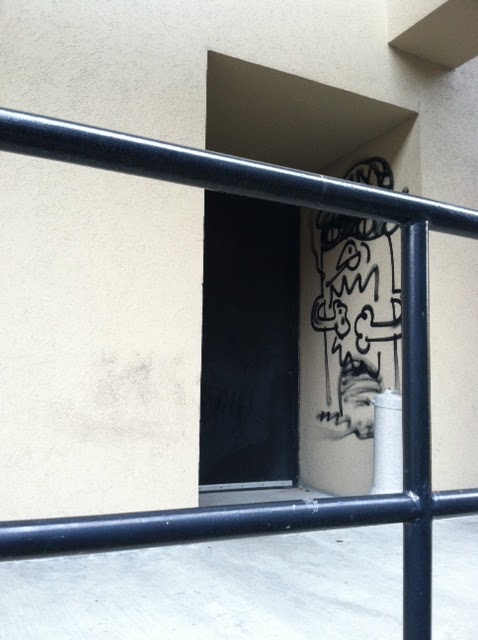
I wish I had more photos of this process's evolution. You see, an individual or a group has taken to writing the word "love" in different ways, in different places, all over Mission Hill. Given the fading on some of the sites I suspect different people have picked up the can to continue the tradition and that it is not just one person, but I do not know for sure. While the idea of an unspoken trend of picking the graffiti "love" torch could serve as a blog subject a second occurrence caught my attention. It seems that none of the "loves" have been touched, that it, painted or written over by other artists except one. Why? Here's my theory, the only "love" to be written over was in a spot when it was placed over another writers piece. This has resulted in graffiti over graffiti over graffiti over graffiti. There was an original piece of graffiti, a long loosely rendered cartoon-esque face. This was sprayed over by a heart. The heart was then sprayed over by a 666 and what was to me an indecipherable symbol. This was then covered over by more paint to fill in the heart. None of the other "loves" in the neighborhood have been touched. This leads me to believe that the "beef" wasn't with the love but with the fact that whoever wrote it decided to place it over another piece.

People create boundaries long before there is the construction of a wall. I don't believe it's a chicken/egg conundrum. I'm not struggling to see which came first. Monterescu's article detailing the construction of Andromeda Hill in Jaffa got me thinking about the meaning behind conflict and the meaning behind walls.
Multiculturalism is coveted in theory. It's trendy, it's new, it's politically correct. Yet, with all this in mind creating the idea of a multicultural environment is more a goal than actually having one exist. The hill is more of a product than a neighborhood, falsely advertised as the epitome of Israeli/Palestinian fusion. In past classes whenever an article spoke of Israeli/Palestinian fusion is usually meant a discussion of walls was well underway. My goal is not to delve into the Arab-Israeli conflict but having a discussion about Jaffa is almost impossible without mentioning the obvious. Two claims to one land. It's happened in history countless times before and usually the victor physically overpowers the loser creating minority and diaspora in the wake of their triumph. But here the battle isn't over, the tensions have not been resolved, the conflict persists in an urban area, in a setting where many people actively live their lives. More interestingly, we can focus on the walls people construct as a physical manifestation of the boundary that has already been created.
History's Walls: a sampling of walls from around the world aimed at keeping people in, but mostly out. (Not arranged in any particular order.)


The U.S./Mexico Border: The American solution to illegal immigration and smuggling.
All of these walls were the vision of a separation desired and attempted before their tangible presence ever touched the landscape. If I put it too simply they all aim to keep the "good" ones in keep the "bad" ones out. So in this way the gated community serves as a micro-version of what has been going on in places all over the world for a very long time. However, the scale of the gated community is key because it allows you to zoom in on the separation in a consolidated and in this case urban area. While interactions between Mexico and the U.S. at the border go largely un-talked about an urban border incites the same immediate emotions that urban violence creates. The location removes a boundaries from its typical sense, created by state and honored by brick. Instead in an urban setting you see a wall for what it truly is, a physical statement of a previously established sense of who's in and who's out. There is something about the presence of a wall that makes boundaries seem unnatural in a world where boundaries are the norm.
The next series of photos I've selected are the art of the separation walls which are not uncommon to Israel/Palestine. Neighborhoods are often sectored off and removed by tall features. Yet that is not to say people are content or that these walls are "working". In a class last semester we discussed the political motivations of a separation wall yet Urban Anthropology has brought my attention to how individuals confront political installments. So, to inject this blog with some hope, some texture, I've chosen to go back to graffiti and street art to look at the situation from an angle closer to ground level.


-Alexis Brinkman
African Market as a Tourist Destination?
Reading Money Has No Smell has made me more curious about market in general because it serves as a destination for regular customers and tourists. Stoller's conversations suggest the initial transition from the streets with chain stores, or major shopping areas in the city, to the Malcom Shabazz market cost the traders profit but worked well because of decreased police interference. After some browsing I found several travel sites on the Internet reviewing the Market Place as a highly rated tourist destination. It might be that it only appears profitable, but the centralization of African traders in the market seems to have created a solid cultural landmark. This placement helps to cement the traders presence and helps to support Stoller's overall theory of Africanization of New York City. The ways in which the locations (markets, businesses) are advertised or depicted for tourists are very interesting. They seem to play on marketing the location as exotic and the goods as authentic which is a slightly less complicated picture than Stoller paints. Let's take a look!
New York Times Travel Section
This one was particularly interesting... very cheeky. Yet it's a travel incentive, guess I can't be too picky then because it serves its purpose well. Areas of interest are highlighted if you wish for a taste of Nigeria, or a sound of Sierra Leone. There's advice on how to go to the places that sell food by the pound if you wanted to prepare an exotic meal. Also a small guide of what galleries to look at and what restaurants to eat at. It implies heavy migration and mentions a host of countries but doesn't mention Ghana. (Which struck me as odd because Ghanaians appear to be a majority in the book.) Art and fashion exhibits are highlighted but prices on items the article suggests you buy range from $25-95. So the review does not paint the same image as the markets in Money Has No Smell. Perhaps because the highlighted areas are geared towards tourists and diverge from the books focus. Intriguing nonetheless! In a few minutes of browsing appears another aspect of the cultural commodity trend to question.
The Trip Adviser
This one is less formal than the New York Times piece but it's interesting because the market was reviewed by two people. One gentleman called his review, "A Little Piece of Africa." He mostly comments on the merchandise and service. Authenticity is assumed in both reviews. It is interesting to see how the nature of the goods goes unquestioned, especially after Stoller's book details the not entirely African disconnected chain of production which most of the items go through. Even more interesting is that 1,218 people rated this review as helpful. That's an incredible amount of mass appeal for a review! I wasn't expecting such a high rate of traffic after seeing only two people had written about the market.
Yelp!
This site was also for the Malcolm Shabazz market and had more reviews but not the abundance I was hoping for. Reading peoples opinions to contrast with what Stoller is writing might not be all that useful but it sure is making me think about how the book changed my perception or maybe swayed my focus on the market place. It's odd to have it painted as purely a destination to shop when I had started to think of it as a microcosm, as a body affecting the city. The reviews though, I've used interesting too much but I don't know how to else to describe it, are so interesting! Here's one from Janeen D. in Colorado,
I came here around 3PM on a Thursday afternoon. Just happened upon it while walking Harlem. Pretty cool place and fun people working there who will try to talk you into a deal with whatever you may be looking at or touch.
Fun jewelry, reasonably priced, and nice, almost too nice people who work there. Had a fun convo with a guy who had three wives and was extending an offer to me to be his fourth wife! No thank you, but I will definitely shop here again!
I wonder if he really opened up to her about his three wives and if so I'm a little jealous because most of my anthropology classes and the book suggest such personal information is usually hard to get from individuals.
There's also Jonathon from California who divides the goods between African merchandise and Harlem souvenirs. A common trend in the reviews clearly mark the distinction between the true African goods and NYC souvenirs that are more ubiquitous to the city.
What does it all mean? I'm not sure but I'm very curious. Based on the reviews it seems like people come to the places described in Money Has No Smell for a purely African experience. Most people were disappointed about the lack of food at the Malcolm Shabazz market which suggests the ideal experience includes, goods, conversations, and snacks. I can't lie the total package sounds fun but comparing the book to a tourist experience just draws more attention to how layered the story becomes and how complex the situation is. It suggests that in some ways the city will always override or limit the effect of the Africanization Stoller describes and that experiencing the destination is much different than experiencing something that could be considered a piece of removed or isolated African culture.
- Alexis Brinkman
Policing the City: misapplication or not?
I've been conducting a mini-observational experiment. As daylight savings time began to creep closer I began to notice the odd effect the diminishing amount of daylight had on the parking lot behind my house. Up on the third floor I sit in a tree-house like addition that appears to be quite literally attached to the siding of my apartment building supported by trees, to spy on the parking lot intermittently. I noticed that there were several tall lamps were arranged in grid formation and lit the entirety of parking lot. I have no concept of what the lot serves since my knowledge rests only on a birds eye view but here's some objective information.
- At most I've counted seven cars in the lot.
- The cars are what I would consider to be average makes and models. A van, a truck, but mostly early to mid 2000's style sedans.
- The lot is lit from before dusk and are still on early in the morning.
- By seven pm the lot is almost always empty. I've yet to see a car in the lot overnight.
- Cop cars patrol the roads bordering the lot and often turn down the alley road that links the building to the lot.
- Since it has become darker earlier there appears to be an increase in patrols.
The area is walled up by a large fence with barbed wire at the top. The only entrance point is one that faces the building, the road, several lights, and what appears to be an automatic gate. Yet every time I watch a cop car come down around the traffic circle, along the street they slow down as they pass the lot. Perhaps there is some type of training they've received about the dangers of restricted lots by troublesome neighborhoods. Yet I can't get beyond the fact that in the lot, in the dark, what crime beyond trespassing could some one even hope to commit? There's no cars to break into, there's no people to harass.
The cops on the other hand rarely come down my street. Oddly enough the only crime I've ever witnessed happened right across from my building. At 1:46am last Saturday a young man was attempting to hurl a large chuck of cement through a window on the lowest floor of a building. I walked past him and couldn't help but look. Judging by the way he blankly stared at me and shuffled from leg to leg I'm going to guess he was extremely intoxicated. He starred confused at me for a bit but probably only to see if I was calling the cops. I scooted with remarkable speed to the safety of my building and raced up three flights of stairs so I could watch him from my window like an aspiring anthropology student would. In short he attempted to crack the window several times but failed.
If he had been doing the same activity a couple hundred feet behind where we were standing he probably would have been arrested due to the increased chance of a cop seeing him.The whole situation of my earlier observation and the glass-breaking incident made me think about more about the regulatory sanctions of the city the African traders in New York are subject to. In some areas they are fined, in some areas they are left alone. Are police patrolling where they expect crime to take place or the places crime is considered unacceptable?
I can't say for sure. Perhaps with more thought and research this could morph into a rounded thesis, until then I leave you all with a link to an interesting article from Cracked.com that suggests how seemingly awful ideas have helped to solve global problems such as crime, suicide, corruption. Enjoy!
- Alexis Brinkman
Violence, Protests, and Clarification of the Occupy Together Movement
I've been thinking a lot about violence and protest. The best I can surmise from a brief (and hopefully) intellectual survey of the situation is that we impart as much violence as we expect to receive. If democracy hasn't fulfilled our purest hopes and desires for equal representation then it has at least secured a landscape where violent reaction on the part of law enforcement towards protesters still begets a horrified and publicized media reaction. That is to say no one going out to demonstrate on Wall Street or any other location feared that they would be gunned down by a faction of leather-booted enforcers in the name of peace and quiet. Yet, if you're sliding on a scale from dead to bruised it is not inaccurate to say that people were received with brutality. Not that I'm in favor of any use of force against peaceful protesters but I would have to argue that this brutality is at least in form equal to what was expected (even if it's not what actually occurred). The police expected rowdiness, they expected difficult arrests and unruly participants. Burning cars, tipped over trash cans, maybe a broken window, that's as bad as it usually gets. Even when you consider tragic isolated events of death and severe injury it is nothing compared to the violence experienced in Tunisia, Libya, Egypt, or Syria. But I would argue that's because when you rally against a violent government aren't there expected violent results? If you use intimidation, force, and fear to contain people then when they rise up against you it wouldn't be far-fetched to imagine a violent and chaotic upheaval ousting you from your palace and ending with a man-dangles-from-rope-tied-to-fast-horse type of situation. Therefor, even though it may not be right or fair, couldn't it be sufficient to say that in both scenarios the expected amount of violence contributed greatly to the amount of violence that actually unfolded? At best it's an educated guess but I feel very strongly that there is profound truth to the self-fulfilling prophecy phenomena or that if you think something will be that increases the odds of it happening because the thought and subsequent preparation and atmosphere contributes to the unfurling of events.
Part II
Too Vague to Miss?
Sometimes I feel as though the Occupy Together movement is unlike any other demonstration or protest in the world. However most times I suspect this feeling may be because I am as American as the location and therefor my perception of novelty is really just warped pride. Regardless of what its true standing may be, personally I still think it's too soon to tell, one unique facet of the movement is that it's national and multicultural. Americans from all walks of life are joining the collaboration across the United States. Students are a massive portion yes but it gets harder and harder to dismiss as a raving group of hippies when you have people of all ages and ethnicity coming out in support of change. So why are people still giving such stiff critique? I see a variety of membership and a clear message. After all change and a good dosage of hope did serve as the vague call for Obama supporters to rally. If it was specific enough for politics first why is it too vague for a protest? Here it has even been narrowed down further with the elimination of hope in favor a focus on change. Why are they protesting? They want change. In several categories, for several reasons, much like Obama's campaign strategy which was met with cheers and enthusiasm. I say the protesters deserve the same support or at the very least an ease of constant questioning from news affiliates who dubiously seemed shocked that after asking twenty different people what they want, they got twenty different answers. Apologies, they weren't briefed or coached. They weren't handed a script and told when to scowl and when to smile but it's pretty clear they all want change. Each day membership for the Occupy Together movement creeps closer and closer to an accurate representation of 99% of Americans. Perhaps I'm less concerned with the lack of cohesive message because I'm more content with a vague answer or simply more comfortable with a mess but the refining period is happening, organization is continuing, and numbers are growing. In conclusion I pass on the web address (I couldn't get the link to connect) to a recorded speech/transcript from Slavoj Zizek who spoke about what he felt were the core ties of unification for OWS/Occupy Together. I found his words to be one of the clearest signs of consolidation of a message to cut down the general confusion and mystery surrounding the demonstration.
Attempt at the link: clickhere
Website Tag if the link doesn't work: http://wlcentral.org/node/2297
-Alexis
What Creates a City?
I did some wondering over the weekend and started thinking about how cities are created, replicated, and recognized. Is there a certain set of objects a place must contain in order to classify as a city? Can these images be taken out of city and still maintain their integrity or identity as "city items"? Development of a city is a funny thing. It has to happen for a city to exist (surely objects did not amass overnight to create such a body) but rarely have we been priviledged to a specific image oriented documentation of such growth.
This is in no way a photographic display meant to showcase ability or skill. (They were taken on my cell phone in the heat of a brain storm.) So, while the quality may be sub-par I hope you'll see the underlying premise anyway.
I have selected a few photos taken on a journey and wish to know if these representative of a city, a suburb, or a rural town. You can analyze them piecewise or in totality. My main objective was to inquire whether scenes/images/objects could contain the identity of the city on their own through recognition or if inhabiting a city is the only means of acquiring such an identity. If I were to say where these were taken it would spoil the experiment but if you have any questions please feel free to approach me in class.
Alexis Brinkman




Inner City, Inner Self: A Memoir (Alexis Brinkman)